

HPEX® – High Performance Heat Exchanger
Additively manufactured high-performance heat exchanger for compact and demanding heat transfer tasks
HPEX® leverages the geometric freedom of additive metal manufacturing for application-specific optimized flow structures and compact designs. Depending on material, design, and application, HPEX® can be designed for temperatures up to 800 °C and pressures up to 63 bar.
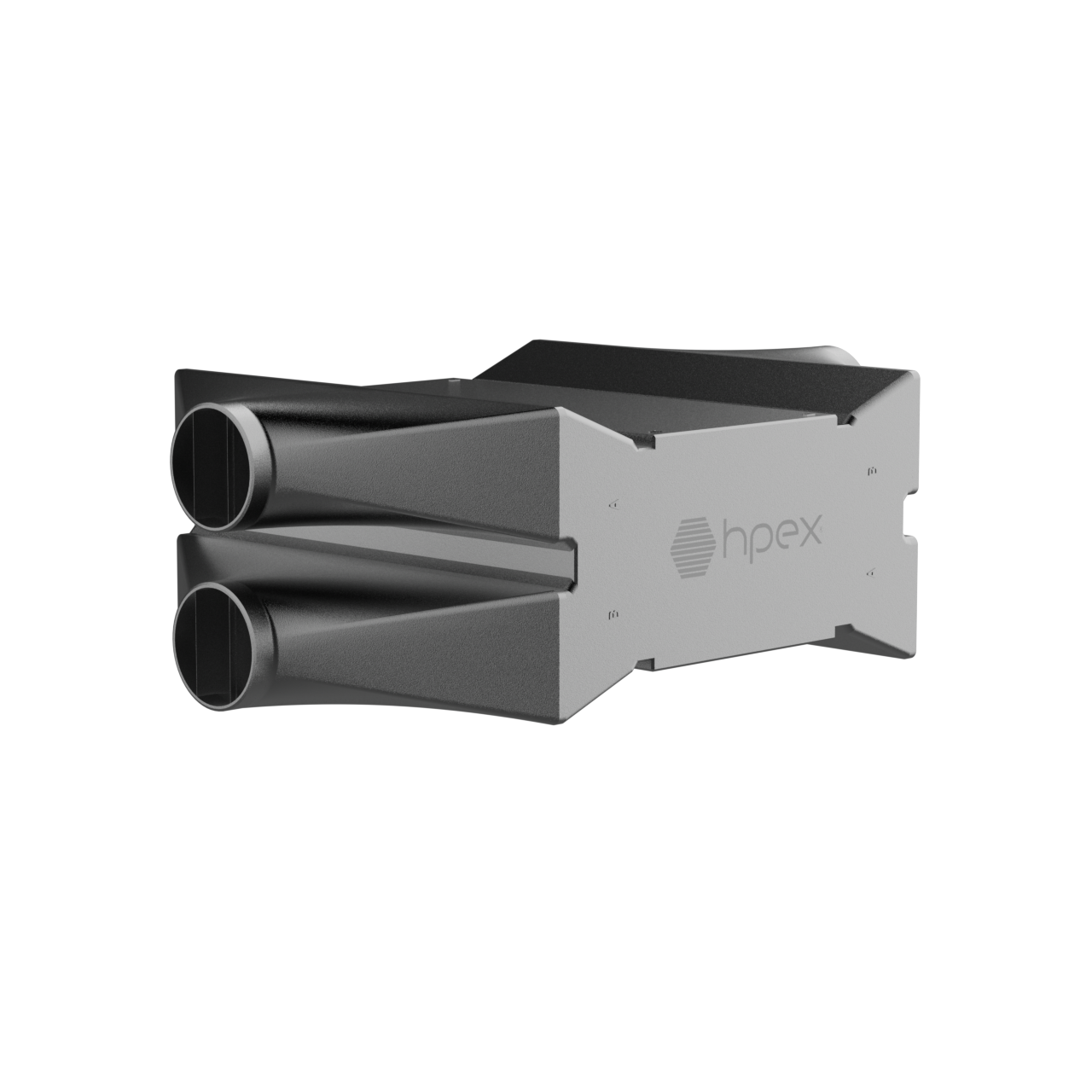
HPEX® Key Facts
- Manufacturing processLPBF (Laser Powder Bed Fusion)
- Temperatureup to 800 °C*
- Pressureup to 63 bar*
- MaterialsStainless steel and nickel-based alloys
- Design / Codeper PED 2014/68/EU and EN 13445 (additively manufactured pressure equipment)
- Designapplication-specific and performance-optimized
- Form factorcompact and flexibly adaptable to available space
Vorteile
- High power density: high heat transfer performance within the available installation space
- Integral design: fewer individual parts and joints reduce potential failure points
- High temperatures: for demanding thermal operating conditions in a compact design
- Targeted material use: wall thicknesses and material use can be tailored to the application
- Optimized design: application-specific optimization of flow routing and installation space
- Material efficiency: reduced material use and less waste with high-value materials
- Complex geometries: internal flow structures and external shape can be adapted
- Flexible scalability: channel count, channel length, and module combination can be adjusted
HPEX® – High Performance Heat Exchanger
HPEX® leverages the geometric freedom of additive metal manufacturing for application-specific optimized flow structures and compact designs. Depending on material, design, and application, HPEX® can be designed for temperatures up to 800 °C and pressures up to 63 bar.
* depending on material, design, and application
Technology and technical data
The HPEX® heat exchanger core is produced using the Laser Powder Bed Fusion (LPBF) process. Fine flow channels, complex distributor structures, and geometric functions are integrated directly into the component. This allows heat transfer surface area, flow routing, pressure drop, and installation space to be precisely matched to the application.
Scalability and form factors
HPEX® modules can be adapted to different performance requirements via channel count and channel length. More channels enable higher throughputs, longer channels increase the heat transfer surface area. For higher outputs, multiple additively manufactured modules can be combined.
The geometry is also not limited to a standard shape: depending on the application, different internal flow structures can be realized and the external shape adapted to the available installation space. The application doesn't have to adapt to the heat exchanger – HPEX® is designed around the application.
Materials and design
High-quality stainless steel and nickel-based materials are available for HPEX®. Depending on material, design, and application, operating conditions up to 800 °C and 63 bar are possible. The material and design potential extends up to 1,000 °C, depending on material and design.
The starting point for every design is the specific technical task: which media exchange heat? What temperatures and pressures occur? What performance is required? What requirements exist for pressure drop, material, and installation space? Based on these parameters, ZILONIS handles the thermal and mechanical design and develops an application-specific heat transfer solution.
Application areas
HPEX® opens up new possibilities wherever high heat transfer performance, demanding operating conditions, and limited installation space come together.
• Industry: industrial waste heat recovery, micro gas turbine recuperators, fuel cell and reformer peripherals
• Power-to-X: e-fuels, methanation, and hydrogen process technology
• Chemicals and petrochemicals: specialty chemicals and process gas technology
• Research and development: test rigs and research facilities
• Aerospace: temperature control and cooling tasks under demanding conditions
Expertise for demanding heat transfer
HPEX® combines application expertise with additive metal manufacturing. The technology is based on several years of research and development work by Rosswag GmbH together with Hülsenbusch Apparatebau GmbH & Co. KG and Leibniz University Hannover. Rosswag contributes more than 100 years of experience working with metal materials, as well as a complete process chain from metal powder production to the tested, additively manufactured component.
ZILONIS holds the exclusive marketing rights for HPEX® and complements the manufacturing expertise with thermal and mechanical engineering, pressure equipment expertise, and experience in industrial heat transfer applications. As a technology and solutions provider, the focus is not on the manufacturing process itself, but on the technically and economically appropriate solution for the specific use case.
Technical Data
- Manufacturing processAM process: Laser Powder Bed Fusion (LPBF)
- Temperatureup to 800 °C*
- Pressureup to 63 bar*
- MaterialsStainless steel and nickel-based alloys
- Material / design potentialup to 1,000 °C, depending on material and design
- Design / Codeper PED 2014/68/EU and EN 13445, taking into account the requirements for additively manufactured pressure equipment
Request a design for HPEX®
Not sure whether HPEX® is the right technology for your application? Talk to us – no obligation, technology-agnostic.
FAQ on HPEX® and additively manufactured heat exchangers
APPLICATION-SPECIFIC
Your markets are our markets. Every year, over a thousand products leave ZILONIS to be deployed worldwide, tackling the most demanding challenges.

/chemie-und-petrochemie.jpg)
/energietechnik.jpeg)
/pharmaindustrie.jpg)
/gebaeudetechnik.jpeg)
/holz-und-papierindustrie.jpeg)

